For founders: the 30-second explanation
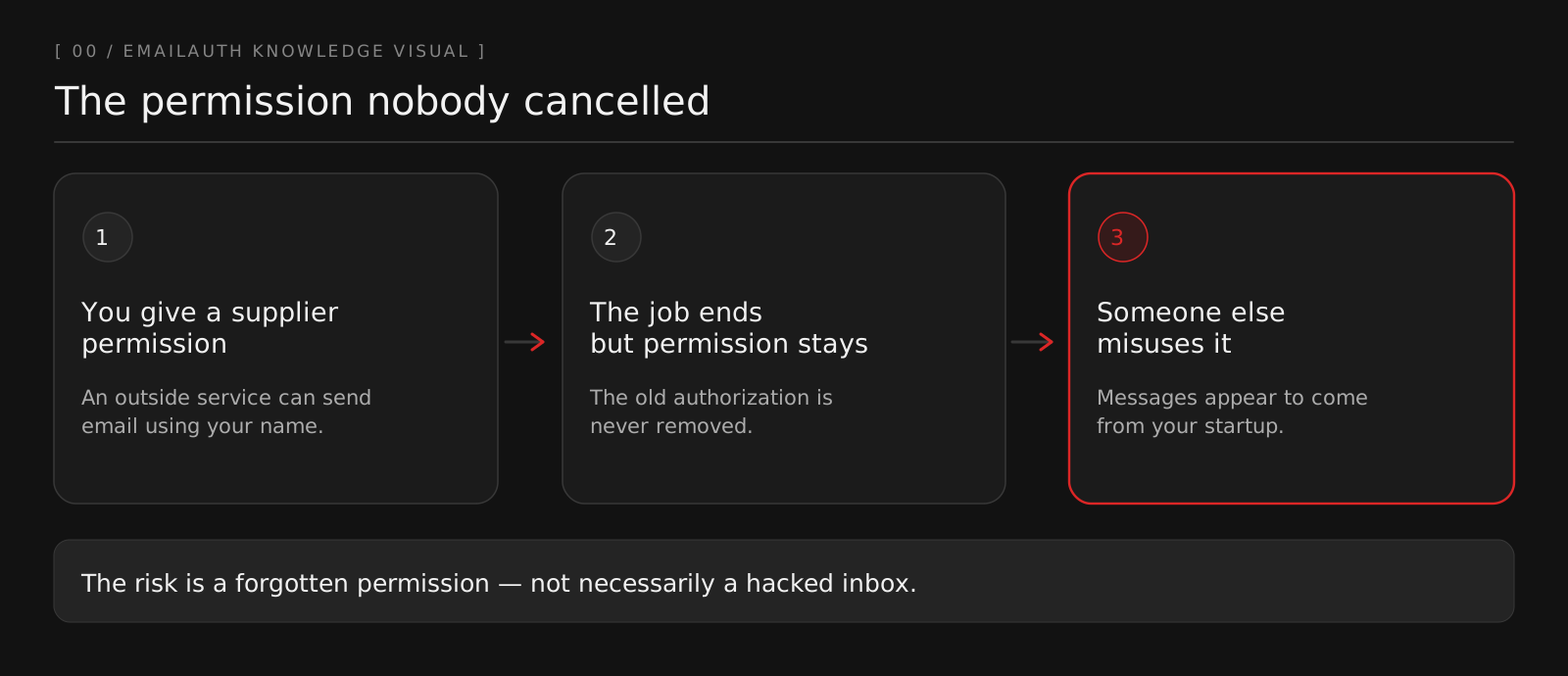
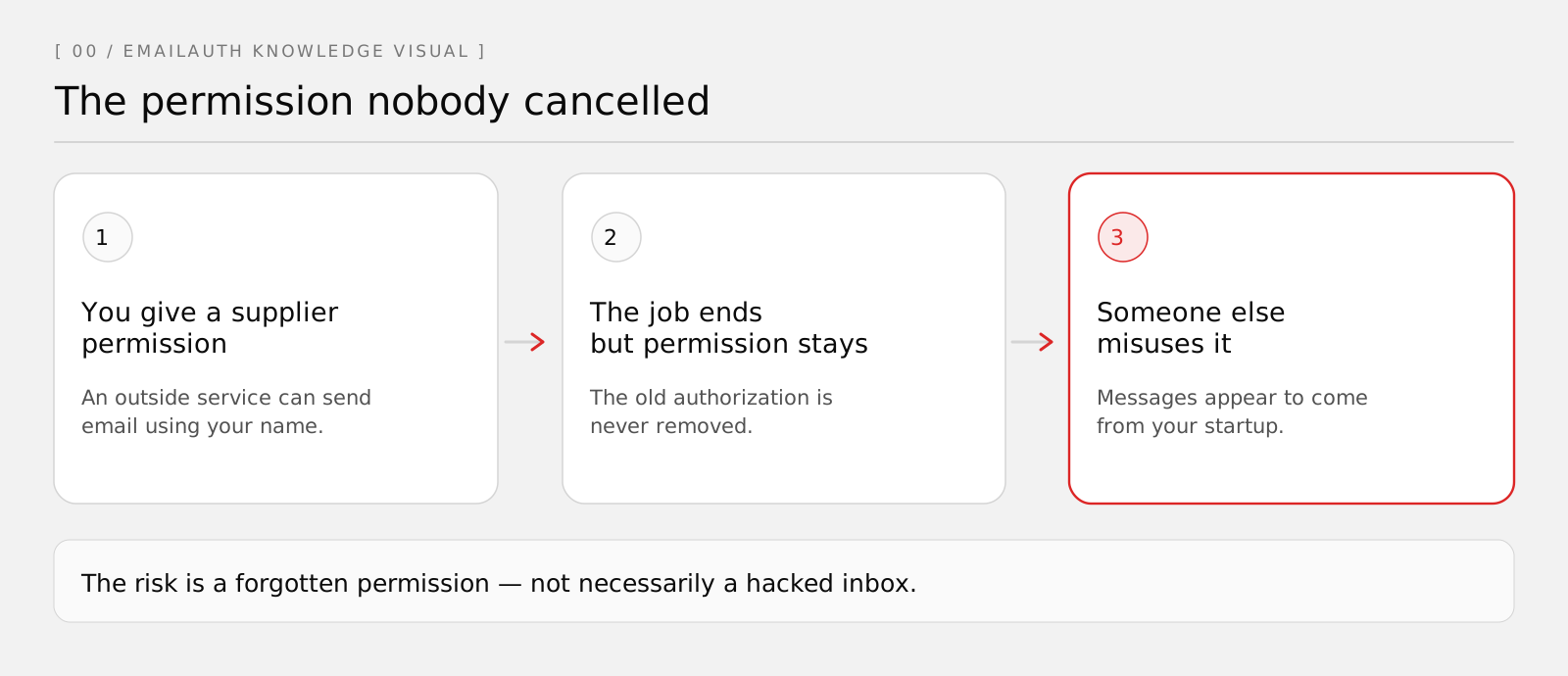
Imagine your startup lets a marketing company send emails using your company's name.
The project ends, but nobody cancels that permission.
Later, a criminal gets control of the old service. They use the forgotten permission to send emails that appear to come from your startup. Some security checks may even say “approved.”
That's SubdoMailing: abusing an old permission to send emails in your company's name.
No one needs to hack your inbox. The problem is a permission you forgot to remove.
Ask your IT team: “Which outside services can still send emails as us? Do we still use and trust all of them?”
The fix: find old services, check who controls them now, and safely remove permissions you no longer need.
The detailed explanation
Your DMARC policy may be working exactly as designed. The problem is that an old DNS dependency may now be answering for someone else.
A company retires a campaign, cancels a supplier or closes an old product. Months later, the marketing team has forgotten it. The application is gone. But one DNS entry remains.
To a criminal, that leftover entry can be an opportunity: recover a domain or resource nobody is maintaining, make DNS return an attacker-controlled answer, and use a trusted organization's name to send mail. In certain configurations, the resulting message can even pass SPF and DMARC.
This is the idea behind SubdoMailing—a family of email-abuse techniques that exploit forgotten subdomains and stale domain dependencies. It turns a housekeeping failure into an impersonation problem.
TL;DR
- What it is: SubdoMailing uses abandoned or misconfigured DNS dependencies to send deceptive mail through the reputation or authorization path of a legitimate domain.
- Two primary routes: an abandoned CNAME lets an attacker influence a subdomain's DNS answer; a forgotten SPF dependency can let attacker-controlled sending IPs appear on your authorized-sender list.
- Why it matters: an SPF or even DMARC
passdoes not prove the mail is trustworthy. It proves specified identities passed checks against the DNS answers available during evaluation. - The first check: list every active and retired mail-related domain and subdomain, expand nested SPF records, and verify who controls every outside dependency.
- The fix: retire unnecessary records with owner approval, contain confirmed compromises, review mail activity and build DNS cleanup into supplier offboarding. A scanner warning is a lead—not proof of takeover.
Quick check: Inspect your recursive SPF record with EmailAuth®. It can expose nested dependencies and lookup problems. You must separately verify whether a referenced resource is abandoned, claimable or controlled by an adversary.
What is SubdoMailing?
SubdoMailing is the misuse of a legitimate organization's domain, subdomain or email-authentication dependencies to send deceptive email. The attacker often does not need to guess a password, compromise Microsoft 365 or persuade the victim to publish a new SPF record. The opening can already be sitting in public DNS.
The name became widely known in February 2024 after Guardio Labs documented a large campaign involving forgotten DNS references. At the time of that investigation, Guardio reported more than 8,000 affected domains and millions of malicious emails being sent daily. Those are findings reported in 2024, not a claim about the number of affected domains or daily messages today. Guardio Labs original investigation.
There is a particularly uncomfortable lesson here. Organizations invest in authentication so receivers can distinguish authorized senders from impostors. But an authentication record is only as trustworthy as the DNS names, domains, vendor accounts and people behind it. If an attacker assumes control of one of those dependencies, the receiver can reach a correct technical conclusion from an authorization chain that the organization never intended to maintain.
How a forgotten DNS record becomes a mail-sending risk
Not every stale DNS record creates the same attack. These are the two mechanisms every domain owner should understand.
Path 1: a dangling CNAME
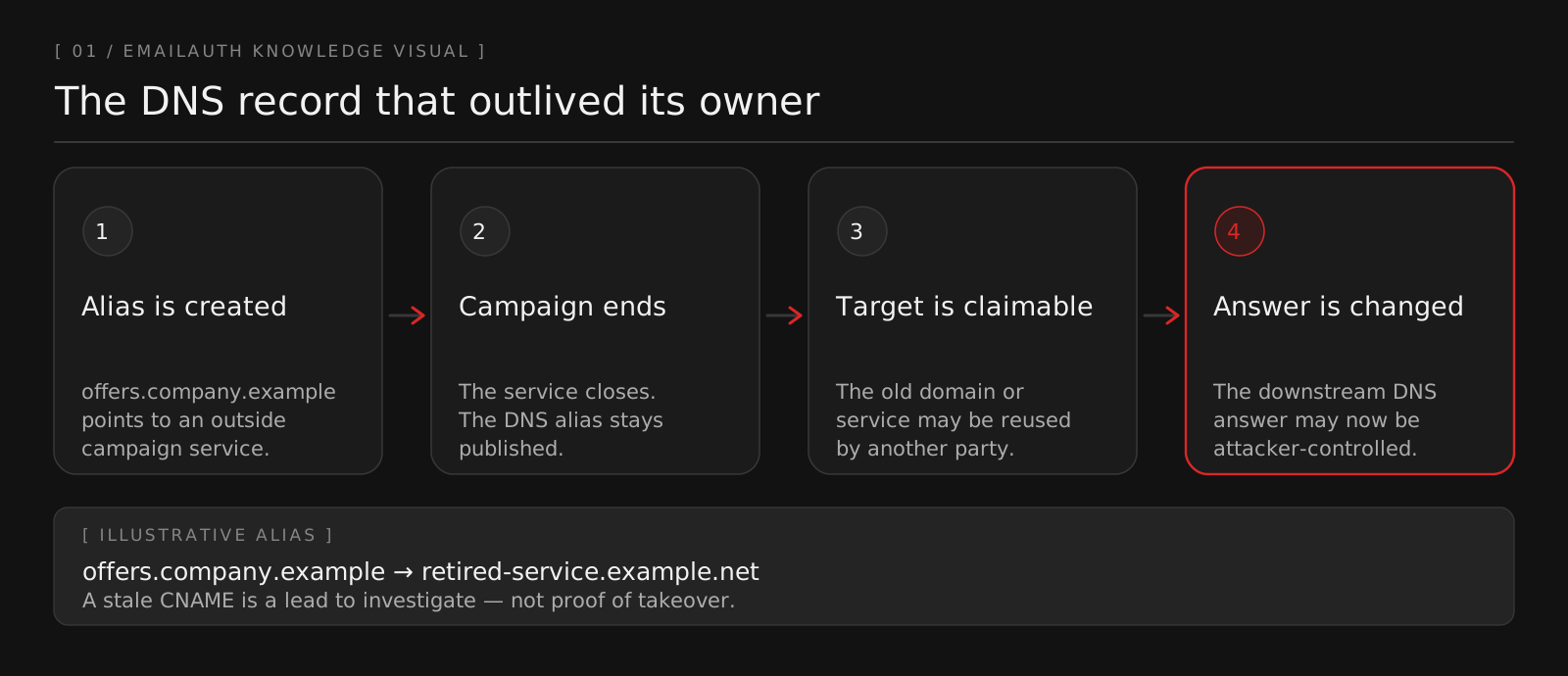
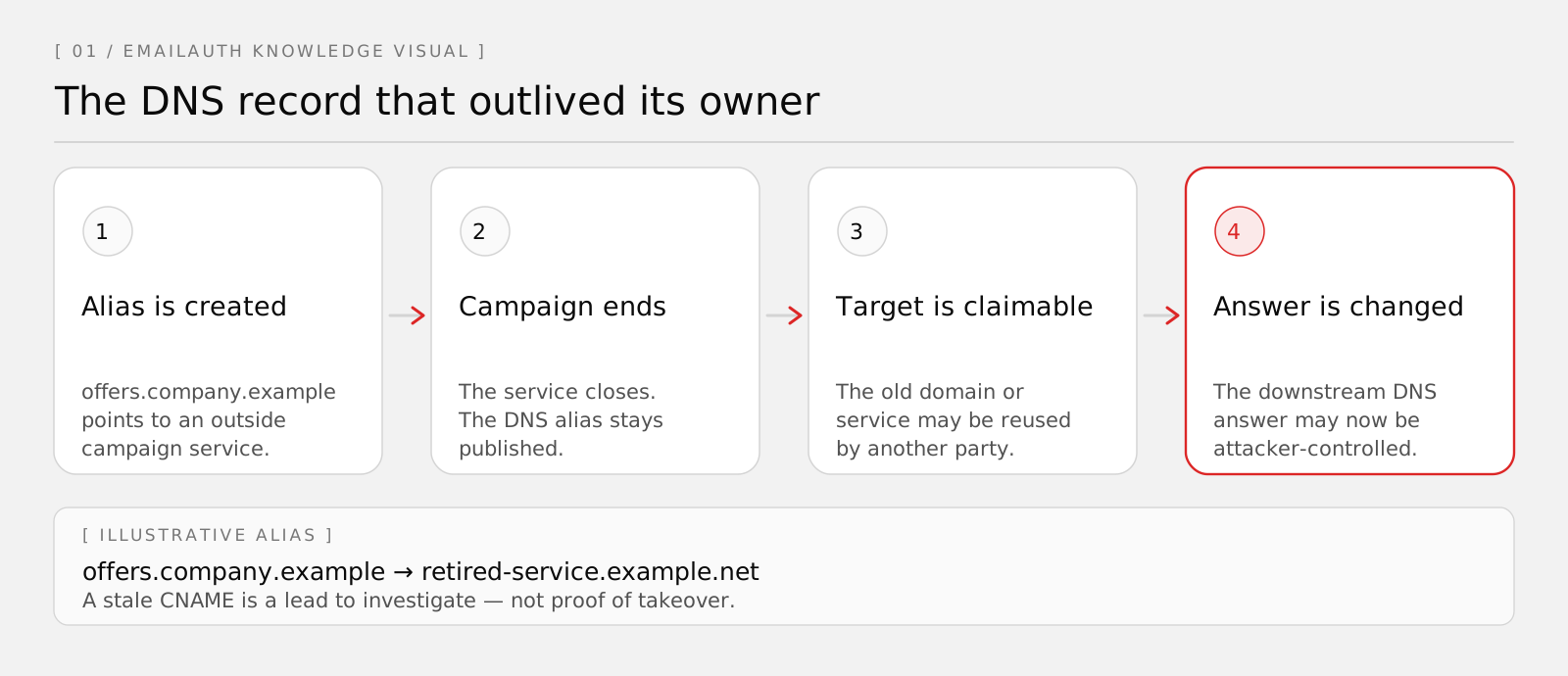
A CNAME maps one DNS name to another. For example, your business might publish a friendly marketing hostname that points to a third-party campaign service.
Illustrative records only—these names are reserved examples, not live domains:
offers.company.example. IN CNAME offers.retired-service.example.net.
At launch, the service works. At campaign end, the supplier account or referenced domain is retired, but the CNAME is not deleted.
If the target domain expires and is re-registered, or a supported hosting service lets someone else claim the referenced resource, a third party may gain effective control over answers reached through the old CNAME. Depending on the configuration, those answers can support web impersonation, mail routing or an SPF policy that authorizes the attacker's infrastructure.
For example, a response following the alias could ultimately expose a policy such as:
offers.retired-service.example.net. IN TXT "v=spf1 ip4:203.0.113.44 -all"
If the receiver evaluates that SPF policy for an aligned sending identity and the relevant DNS and protocol conditions are met, email from 203.0.113.44 can receive an SPF pass associated with the affected name. The address is from a reserved documentation range; it is not an indicator of compromise.
The distinction: A broken CNAME is not itself proof that takeover is possible. Different providers have different resource-claiming rules, ownership challenges and reservation protections. First establish whether the target is really controllable by an unauthorized party. Microsoft documents both the dangling-DNS risk and service-specific protections for Azure. Microsoft guidance.
Path 2: a poisoned SPF dependency
This is even more direct—and can affect an organization's main domain, not only a subdomain.
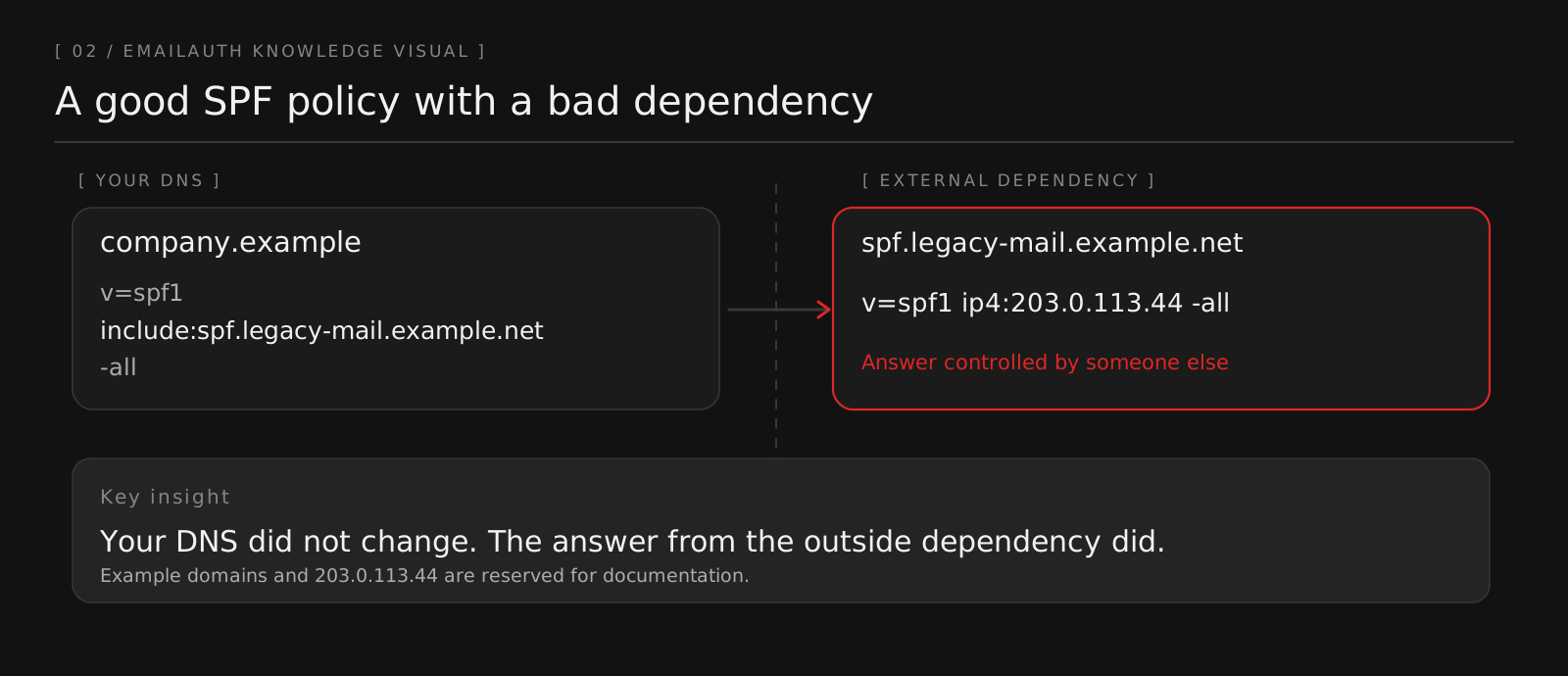
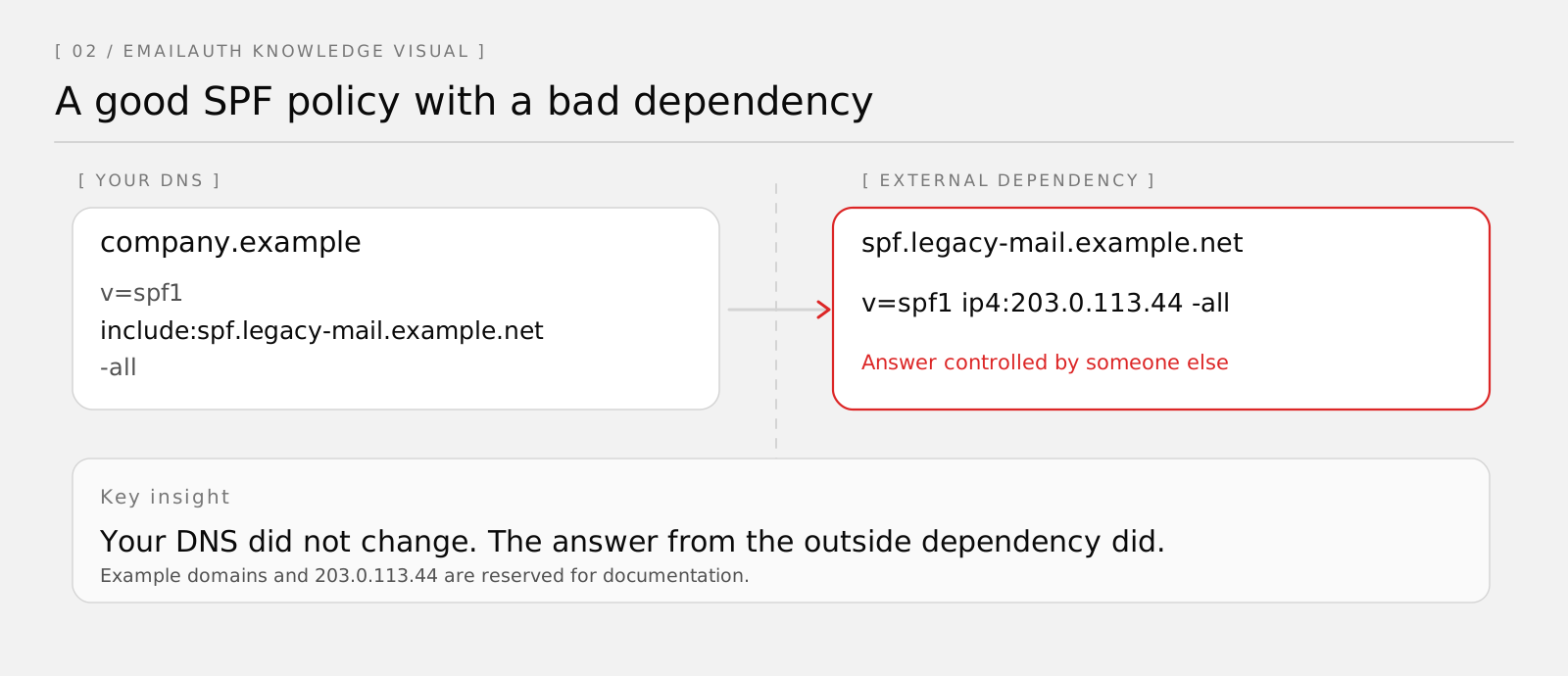
Suppose company.example once authorized a marketing platform using an SPF include:
company.example. IN TXT "v=spf1 include:spf.legacy-mail.example.net -all"
That include instructs an SPF evaluator to check the referenced domain's policy. If the domain or an upstream dependency becomes attacker-controlled, the response can change without anyone editing the company's own SPF record:
spf.legacy-mail.example.net. IN TXT "v=spf1 ip4:203.0.113.44 -all"
An attacker sending from that IP with company.example as the RFC5321.MailFrom domain can now obtain an SPF pass, assuming the full evaluation completes successfully. If the visible RFC5322.From domain is also company.example, SPF is aligned, and DMARC can pass through that aligned SPF result—even if DKIM does not pass.
The authorized list may have appeared conservative. It even ended in -all. The bad dependency matched before the final -all was reached.
Also inspect other SPF mechanisms and redirects: a, mx, exists, redirect=, and nested includes can depend on records outside your control. Their evaluation semantics differ; a scanner must trace the real path for the relevant sending IP rather than simply count the words include:. SPF defines a limit of 10 evaluated DNS-lookup-causing terms, including recursive processing. RFC 7208 · EmailAuth guide: SPF lookup limit.
Other related takeover paths
NS delegations, stale MX targets, third-party SaaS hostnames and reused cloud resources can create related control problems. They are not automatically SubdoMailing incidents, and a mail-sending consequence must be demonstrated separately. Nevertheless, they belong in the same inventory and supplier-offboarding process. See EmailAuth's guide to DNS delegation and dangling records.
Why SPF and DMARC may pass even when the mail is malicious
Consider these three identities in a message:
| Signal | What the receiver evaluates | What a passing result does not prove |
|---|---|---|
| SPF | Whether the connecting IP is permitted for the RFC5321.MailFrom domain (or a relevant HELO identity) | That the business still intended to authorize every nested DNS dependency |
| DKIM | Whether a cryptographic signature validates for its signing domain and covered content | That the sender's purpose or requested action is benign |
| DMARC | Whether SPF or DKIM passes and the passing identifier aligns with the visible From domain | That a user, vendor or sending system is still approved by the organization |
This is an important distinction between protocol authorization and organizational intent.
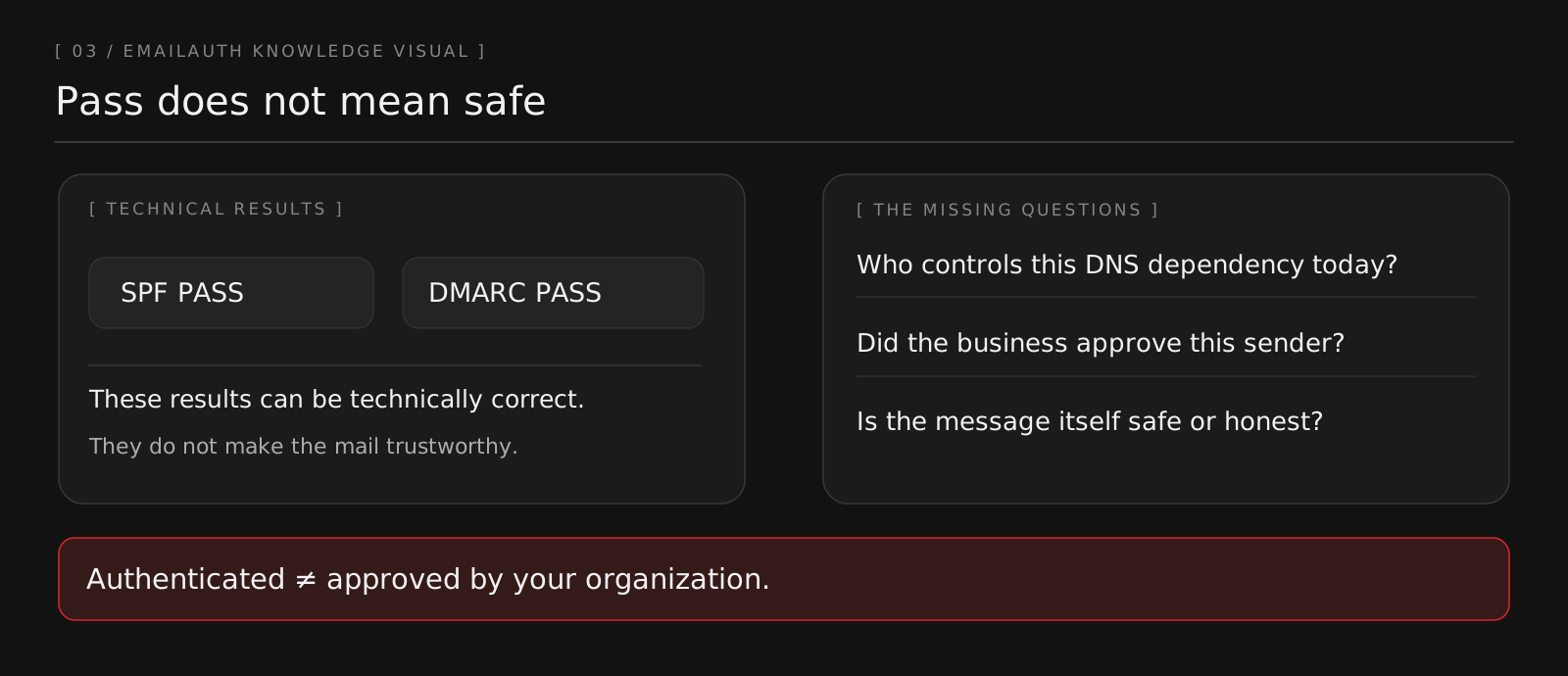
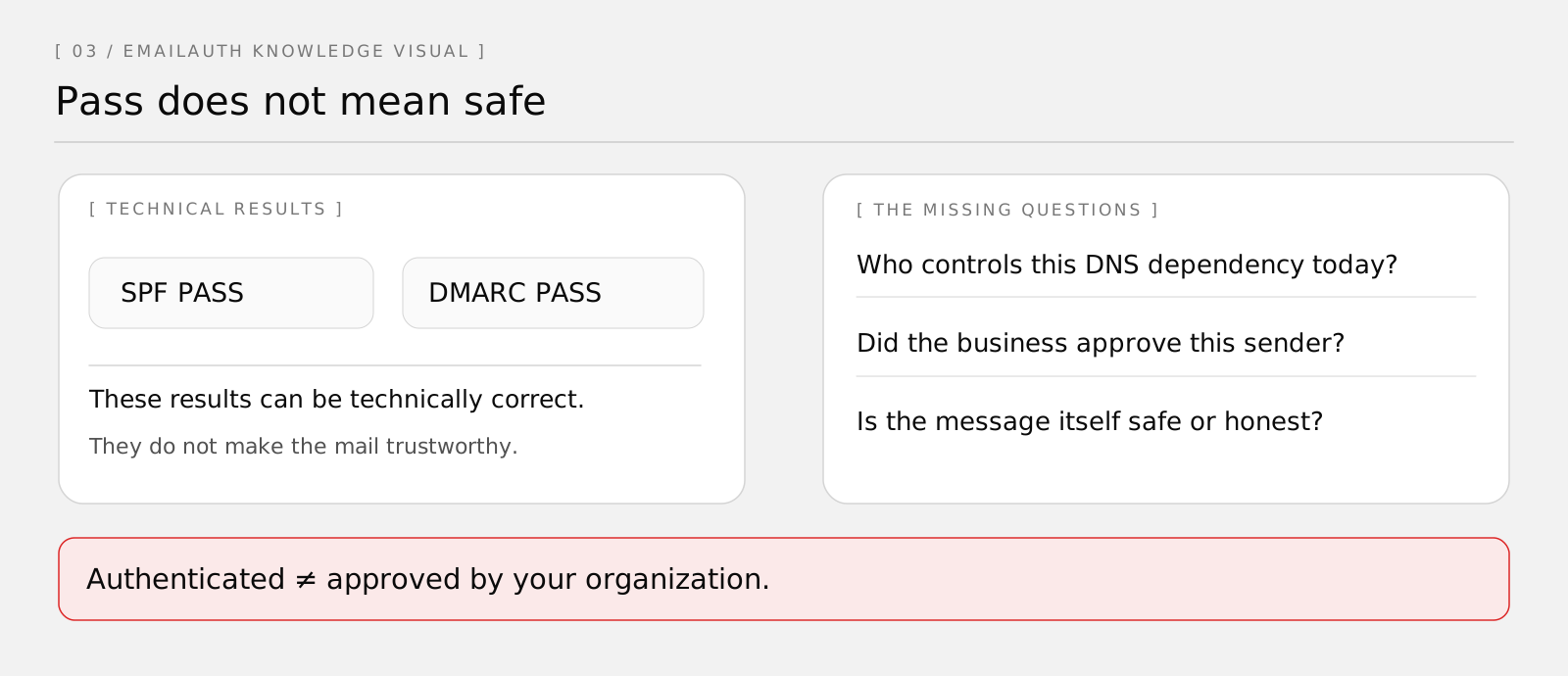
SPF checks the authorization published through DNS at evaluation time. DMARC checks whether a passing SPF or DKIM identity aligns with the message's visible From domain. Neither protocol independently establishes whether an internal procurement team still uses a supplier, whether a hosting account has changed hands, or whether a phishing email contains a fraudulent payment instruction.
The current DMARC standard, RFC 9989 (May 2026), expressly explains that a DMARC pass does not assert the inherent value or trustworthiness of the content; a receiver may still apply anti-abuse controls. RFC 9989, Section 5.3.
Would p=reject, sp=reject or np=reject solve it?
Not by themselves. These policies express how receivers should treat mail that fails DMARC. If a poisoned SPF dependency has already authorized the attacker's server for an aligned domain, the malicious mail may pass DMARC, so an enforcement policy does not trigger the expected rejection.
Current DMARC policy discovery also distinguishes an existing subdomain (sp, when applicable) from a non-existent one (np, when applicable). These controls are useful for other spoofing scenarios, but neither repairs a forgotten DNS dependency. The v=DMARC1 version remains unchanged under RFC 9989. The historical pct, rf and ri tags were removed by the current specification. Review interoperability before tightening enforcement on domains whose users participate in mailing lists or other indirect flows. EmailAuth DMARCbis readiness guide.
Bottom line: You need correct authentication, an inventory of approved senders, and continuing control of the DNS dependencies that make the authentication result possible.
What happened in the real SubdoMailing research?
Guardio's February 2024 investigation connected deceptive mail to dormant infrastructure associated with well-known organizations. One example involved an old msn.com campaign subdomain whose CNAME still referred to an unrelated campaign domain after the original activity ended. Researchers reported that the old destination had subsequently been registered by another actor and that the DNS answers enabled abusive SPF authorization. Guardio also documented separate cases in which abandoned external domains appeared in SPF mechanisms and were used to authorize sending infrastructure.
The researchers tracked a campaign they called ResurrecAds, which used revived domain relationships for large-scale deceptive mail and click-oriented abuse. The key evidence was not merely that DNS looked old. It was the combination of historical domain ownership, live DNS authorization, sender IPs and observed malicious emails. Read Guardio's primary research.
The research also shows why a useful investigation needs more than a DNS syntax check. The important link is between a historically legitimate dependency, evidence that someone else now controls its answer, and mail activity using that answer. Without all three, a scanner can mistake an obsolete record for a confirmed compromise—or miss an attacker who is already receiving a successful authentication result. A point-in-time check is therefore evidence to investigate, not a permanent declaration that every subdomain and provider account is safe.
How to check your own exposure
Use a repeatable sequence. The goal is to establish what the DNS record authorizes, who controls the answer, and whether anyone has abused it.
Step 1 — Inventory domains, subdomains and senders
Build a list of registered domains, parked domains, campaign subdomains, event microsites, transactional mail domains, DNS aliases and third-party services. Include businesses you acquired, expired vendor relationships and historic marketing platforms. The absence of a service from your current procurement list is a reason to investigate, not immediate evidence that it is malicious.
Assign each hostname and sending service an accountable owner. If nobody recognizes it, keep it in an unverified state until you have examined the logs, contracts and change history.
Step 2 — Expand SPF all the way down
Read the domain's live SPF TXT policy. Trace recursive include and redirect evaluation and address-bearing a/mx mechanisms. Look for:
- domains registered to old suppliers or unfamiliar owners;
- unexpected authorized sending IP ranges;
- external dependencies that have changed ownership or DNS operator;
- records that resolve differently across authoritative servers;
- newly introduced source IPs alongside a stable-looking top-level SPF policy.
Use the EmailAuth SPF Checker to review recursive includes and DNS lookups. It is a starting point for policy analysis, not a claim that ownership or takeover has been tested.
Step 3 — Inspect the dangling references
Look at CNAME, NS, MX and service-specific alias targets. Validate whether the target resource still exists and who is permitted to claim or configure it. A lookup that returns NXDOMAIN, NODATA or another error may show a broken dependency, but does not establish unauthorized claimability. Check the hosting provider's current protection and ownership-verification model.
For a domain you administer, basic read-only queries can help preserve the starting evidence:
dig +short TXT company.example
dig +short CNAME offers.company.example
dig +short TXT spf.legacy-mail.example.net
dig +short TXT _dmarc.company.example
These are illustrative commands with reserved sample domains. For an actual assessment, replace them only with names in your authorized scope. dig observes DNS; it cannot by itself determine who owns a resource, whether it is claimable or whether an attack occurred.
Step 4 — Compare DNS to real sending behaviour
Use DMARC aggregate data and permitted mail-platform logs to look for new senders and unusual changes. Compare:
- First-seen IP addresses and sending domains;
- The RFC5321.MailFrom domain versus RFC5322.From domain;
- SPF, DKIM and DMARC outcomes including alignment;
- Volume spikes, formerly unused subdomains and suspicious traffic patterns;
- Vendor records and the actual service owner;
- Historical DNS snapshots, where available, to establish when a referenced answer changed.
Do not limit the review to DMARC failures. In a poisoned-dependency scenario, unexpected successful authentication can be the more important signal. Aggregate reports are useful but are not a complete forensic record of message content or all recipients.
Step 5 — Classify the evidence honestly
| Finding | Interpretation | Suggested urgency |
|---|---|---|
| Observed abusive mail plus an attacker-controlled authorized dependency | Likely or confirmed active incident; preserve evidence and coordinate containment | Critical |
| Independently verified externally claimable CNAME or expired SPF dependency | Demonstrated takeover opportunity; act before abuse | High |
| Stale reference or unknown vendor ownership, with no proof of claimability | Exposure requiring validation, not proof of compromise | Investigate promptly |
| Record is unnecessary, fully owned and not externally claimable | Hygiene item; remove through approved change control | Scheduled cleanup |
This is a triage guide, not a CVSS calculation and not a substitute for the organization's risk methodology.
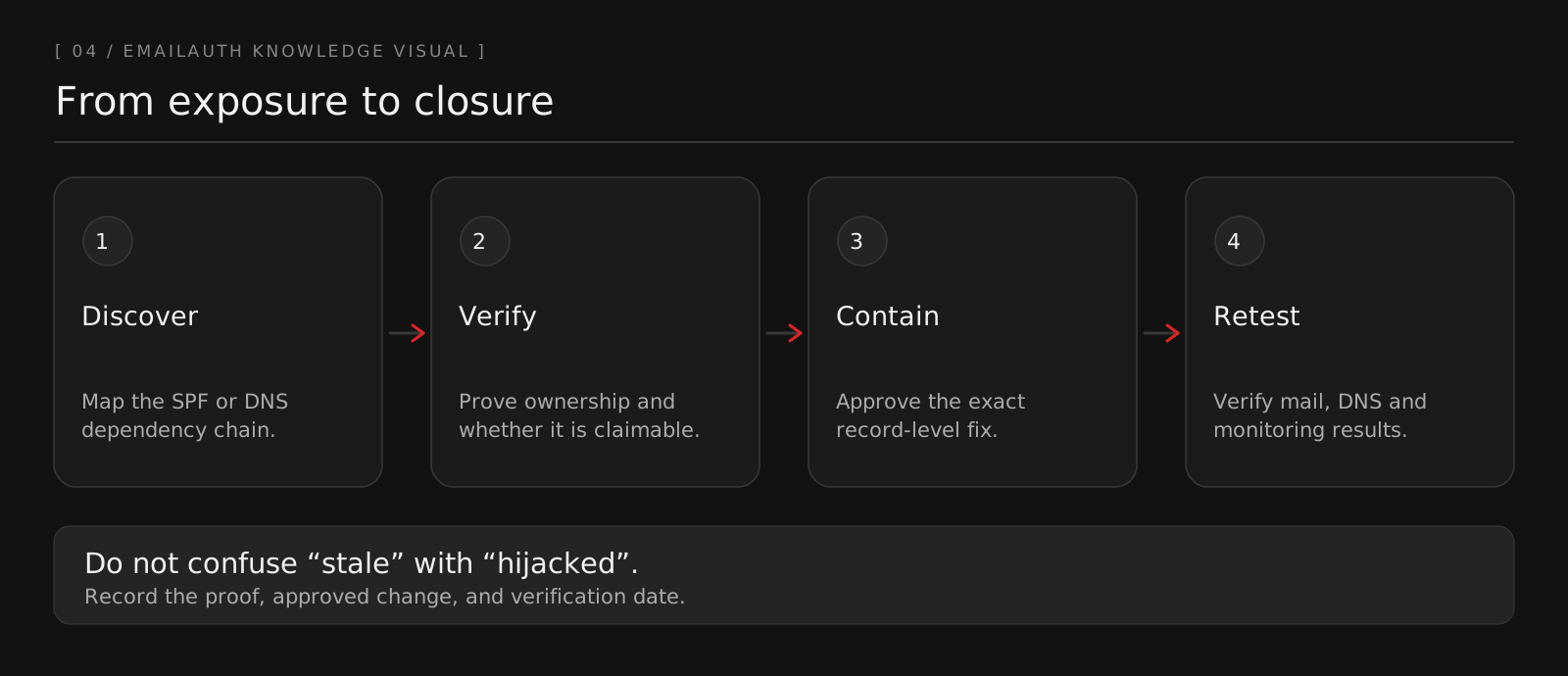
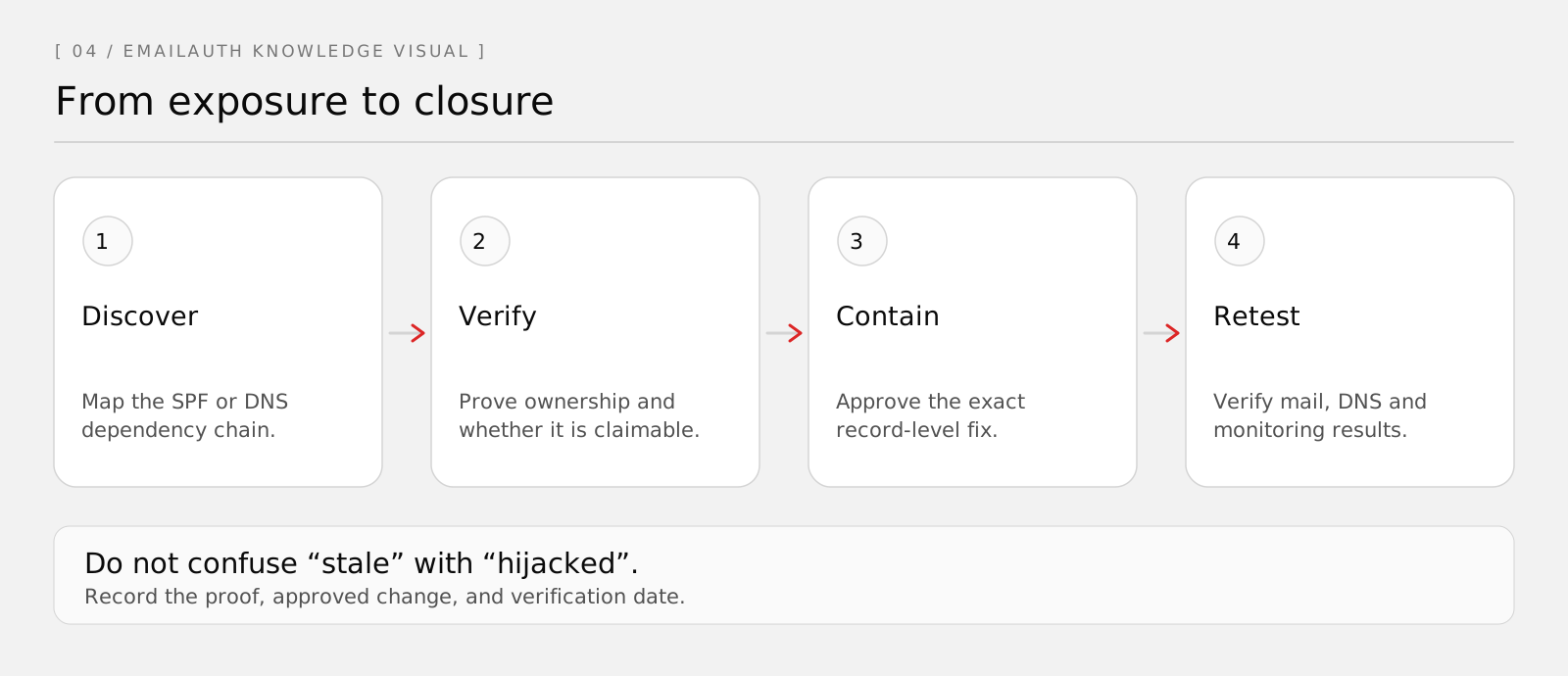
Response playbook: from discovery to closure
If you find a stale reference but no evidence of attacker control
- Record the exact DNS owner name, type, value, authoritative answers, timestamp and who owns the linked business service.
- Confirm whether any mail, website, analytics, login or customer workflow still uses it.
- Check whether the provider reserves the old name or requires domain-ownership verification; do not attempt unauthorized takeover as a test.
- Remove or replace only the obsolete DNS dependency after the designated owner approves the change.
- Retest the relevant business workflow, legitimate sending paths and the authoritative DNS answers after the change. Retain rollback information and recognize that caches may temporarily show old records.
If you confirm an attacker-controlled authorization path or abusive mail
- Open an incident. Preserve mail headers, authentication results, affected sending IPs, DNS snapshots, registrar/RDAP history and relevant provider logs.
- Contain the exact dependency through approved DNS changes; remove a compromised SPF mechanism or dangling alias only after identifying legitimate services that could be affected. Coordinate with the incident lead and DNS owner.
- Recover control of the legitimate domain or supplier association through your registrar or hosting provider, where possible. Involve legal, brand-protection and mail-provider contacts as appropriate.
- Assess impact: which domains were used, what mail was observed, whether related web content or redirects were hosted, and whether any customer or employee action may have resulted.
- Validate closure: confirm the unauthorized IP no longer passes under the affected SPF path, no unintended legitimate sender is broken, and residual DNS caches and reporting windows are understood.
- Monitor for recurrence and notify stakeholders based on evidence and the organization's incident-reporting obligations.
The fastest-looking fix is not always the safest fix. Deleting a still-active ESP include can break password resets, invoices, ticket notifications or bulk mail. Conversely, leaving a confirmed malicious include in production while collecting reports prolongs exposure. Scope and approval determine the right sequence.
Validate related controls: Check your live DMARC record with EmailAuth. Remember: a correct DMARC record is necessary for many protections, but it cannot make an attacker-controlled SPF dependency trustworthy.
Prevent the next forgotten dependency
SubdoMailing is primarily a lifecycle and ownership failure. The durable controls look unglamorous—but they work.
- Give each sending service a real owner. Record what it sends, from which domain, on whose budget and through whose DNS dependency.
- Link offboarding to DNS retirement. A campaign or vendor is not decommissioned until the mail/DNS records and subdomain ownership have been reviewed.
- Review nested dependencies, not only visible SPF text. A single vendor include can recursively refer to other domains.
- Protect registration and service tenancy. Keep necessary domain registrations renewed; enable registrar MFA and controlled renewal ownership; use provider-specific hostname verification and reservation features.
- Treat DNS changes as security changes. Use scoped permissions, proposed-record diffs, approval, audit logs and validation after publication.
- Monitor unexpected passing senders. Distinguish a legitimate new SaaS rollout from an unapproved IP or subdomain suddenly producing authenticated mail.
- Separate DNS existence from ownership evidence. A record that resolves is not necessarily safe, and an NXDOMAIN is not by itself a take-over finding.
- Include mergers and shadow IT. Nobody's asset inventory is perfectly current. Budget for discovery as well as declared suppliers.
For more on putting this into an operating model, read Maintain a dependency map for SPF, DKIM, DMARC and transport policies and Expired domains and authentication dependencies.
What this means for your role
IT / Mail Admin — prove which record authorized the IP
Your central question is: “Show me the exact DNS evaluation path that made this IP pass.”
Start with the visible From domain, envelope MAIL FROM identity, connecting IP and raw Authentication-Results evidence. Expand the actual SPF evaluation path. Confirm external domain registration and the vendor account that should control it. Preserve a before-and-after record of the DNS change and test legitimate mail from the affected system.
Deliverable: a dependency tree, actual sender inventory, owner assignments, exact-record change plan and post-change authentication evidence.
CISO / SecOps — distinguish real abuse from stale configuration
Your central question is: “Do we have a security exposure, unauthorized control or observed exploitation—and what proves it?”
Make sure DNS, email security, vendor management and incident response share evidence. Ask for confirmed ownership, first-seen sending IPs, approved remediation and the potential effect on business mail. Track critical findings separately from warnings that still need validation. Keep the incident narrative precise for auditors and the board.
Deliverable: risk classification with evidence, named control owner, containment status, residual risk and a date for the next validation.
Founder / Business Owner — stop paying for services you stopped controlling
Your central question is: “Which old suppliers and campaigns can still speak in our company's name?”
The risk is that an unused account or forgotten marketing campaign retains influence over your email identity. Ask your IT team for a list of all sending services—including services nobody actively uses—who owns each one, and the schedule to remove or protect orphaned dependencies. This is about customer confidence and business continuity as much as security tooling.
Deliverable: one accountable owner, a short list of high-risk dependencies and proof that the riskiest ones have been closed.
SubdoMailing checker: what should a useful scan actually tell you?
A useful SubdoMailing review should provide more than a green or red result. Ask for the following evidence:
| A defensible finding includes | Why it matters |
|---|---|
| The exact domain/subdomain and DNS record | Identifies what needs to be changed |
| The full SPF or CNAME dependency chain | Separates the root cause from a downstream symptom |
| Current ownership and claimability evidence | Prevents an ordinary broken service being labelled a takeover |
| Observed IPs, timestamps and authentication alignment | Helps distinguish an exploitable configuration from observed mail abuse |
| Business owner, approved fix and post-change test | Ensures a safe and auditable closure |
Guardio published a checker for cases identified in its original SubdoMailing research. For your own authentication configuration, the EmailAuth SPF Checker analyzes the recursive SPF dependency graph, while the EmailAuth DMARC Checker interprets the published DMARC policy. These serve different purposes. None should be treated as a universal guarantee that no off-platform SaaS account, dangling cloud resource or unknown historical dependency can be abused.
Frequently asked questions
1. Is SubdoMailing the same as ordinary email spoofing?
No. Ordinary spoofing may simply forge a visible From address without a valid aligned authentication result. SubdoMailing exploits a real but unwanted domain-control or sender-authorization path. Consequently, some deceptive messages can authenticate successfully.
2. Does a DMARC p=reject policy prevent SubdoMailing?
Not reliably. It helps receivers handle messages that fail DMARC, but a subverted SPF dependency can authorize the attacker's IP for an aligned domain and allow DMARC to pass. Protect the DNS and service dependencies as well as the policy.
3. Will -all at the end of my SPF record stop it?
No. -all is the fallback when no earlier mechanism matches. A malicious IP authorized through an earlier include, a or another matching mechanism can obtain a pass before -all is evaluated.
4. Can the attacker make DKIM pass too?
Sometimes, but it is not automatic. DKIM signing requires a usable private key and a corresponding validating public key at the appropriate selector under the signing domain. Control over a CNAME target or SPF include alone does not automatically grant control of DKIM selectors. A successful aligned SPF result can be enough for DMARC to pass without DKIM.
5. Does an old CNAME always mean my subdomain can be hijacked?
No. The target service might reserve retired names, require domain verification, or otherwise prevent unauthorized claiming. Establish the exact provider's allocation model and your current ownership evidence before making that assessment.
6. How do I find poisoned SPF includes?
Expand the full SPF dependency graph; inspect nested include and redirect paths plus DNS-dependent mechanisms; verify every downstream domain against your vendor register and actual ownership. Correlate unusual IPs and mail with authentication reports. A static syntax check alone is insufficient.
7. Why would a phishing email show both spf=pass and dmarc=pass?
Because authentication results describe specific technical checks, not whether the message is socially engineered or authorized by a business owner. If a hostile IP is unintentionally permitted by the SPF path for an aligned domain, both results can pass.
8. Does the 2026 DMARCbis standard fix this vulnerability?
RFC 9989 improves and updates DMARC specification details, including policy discovery and subdomain policy handling. It does not remove the need to control SPF dependencies, CNAMEs or retired supplier accounts. The current version string remains v=DMARC1.
9. Are sp=reject and np=reject useful?
They can be useful in their intended subdomain policy contexts for mail that fails DMARC. The sp tag governs applicable existing subdomains; np applies to applicable non-existent subdomains under RFC 9989. Neither negates an aligned authentication pass produced through an attacker-controlled dependency.
10. Can SPF flattening remove the risk?
Flattening may change how IP authorizations are represented and help with lookup-limit management, but it is not a substitute for verifying supplier ownership or approved senders. Static flattened IPs can themselves become stale; dynamically maintained policies still require governance. Review the exact expanded IP set and operational trade-offs before changing production records.
11. Is a “clean” SubdoMailing checker result enough?
No. A point-in-time scan can miss future registrations, cloud-resource claimability changes, business-context gaps and unobserved abuse. Treat the result as one input into continuing DNS and sender governance.
12. What should I do first if I suspect my domain is affected?
Preserve the DNS record and mail evidence, identify the business owner and exact external dependency, assess whether there is evidence of unauthorized control or abuse, and coordinate a scoped, approved change. If active abuse is confirmed, involve your security incident-response process immediately.
Glossary
- SubdoMailing: deceptive mail sent using the authorization or reputation of a legitimate domain or subdomain through hijacked or abandoned dependencies.
- Dangling DNS record: a published record still referring to a retired, unavailable or invalid service relationship; it is not always externally claimable.
- CNAME: a DNS alias that maps one DNS name to another canonical name.
- Poisoned SPF dependency: a referenced DNS name whose answers can be influenced by an unauthorized actor to alter which senders SPF permits.
- SPF include: an SPF mechanism that recursively evaluates another domain's SPF policy for the connecting sender.
- SPF alignment: the relationship between the SPF-authenticated envelope sender domain and the visible From domain, as defined for DMARC.
- DMARC pass: a successful SPF or DKIM authentication result with identifier alignment to the Author Domain; it is not a statement that the message's content is safe.
- Claimability: whether a third party could obtain control of the resource or domain to which a DNS record points under the relevant service's rules.
The EmailAuth approach: keep approval attached to authorization
The lasting answer is to make sender authorization a continuously governed process. Every SPF dependency and sending subdomain needs an identified owner, an approved purpose and change evidence. Historic vendors should not retain silent permission forever merely because nobody remembered to remove a record.
EmailAuth® helps organizations move from authentication reporting toward an AI-assisted, human-governed workflow: understand who is sending, inspect authentication evidence, prepare specific changes for an accountable approver, and maintain the audit trail. Domain-control and supplier-ownership questions still require real evidence, not a confident-looking dashboard label.
Want to review your exposure and the path to stronger enforcement? Start a free EmailAuth assessment or speak with an email security architect.
The question is not only “Does this email pass?” It is “Who still has permission to make it pass—and should they?”
Sources and further reading
- Guardio Labs, February 2024. “SubdoMailing”: original investigation into hijacked subdomains and malicious mail. Primary campaign research and historical observations.
- IETF, May 2026. RFC 9989: Domain-Based Message Authentication, Reporting, and Conformance. Current DMARC core specification, superseding RFCs 7489 and 9091.
- IETF, April 2014. RFC 7208: Sender Policy Framework. SPF evaluation, recursive includes and DNS-dependent limits.
- Microsoft Learn. Prevent dangling DNS entries and avoid subdomain takeover and Prevent subdomain takeovers in Azure App Service. Provider-specific claimability and mitigations.
- EmailAuth knowledge base. DNS delegation and dangling records, SPF lookup limits and DMARCbis readiness. Related practical guidance.